When people first approach Generative Engine Optimization (GEO), it is natural to start by looking at the website.
- Which pages should we improve?
- Should we add FAQs?
- Should headings be changed?
- Should we create more content?
Those can all become useful questions later.
A better place to start is with a different question:
What are people actually asking the AI?
That changes the GEO workflow substantially.
Instead of starting with pages and trying to make them more “AI optimized,” you start with a set of buyer questions and determine whether your existing information adequately answers them.
I walk through this process in the video:
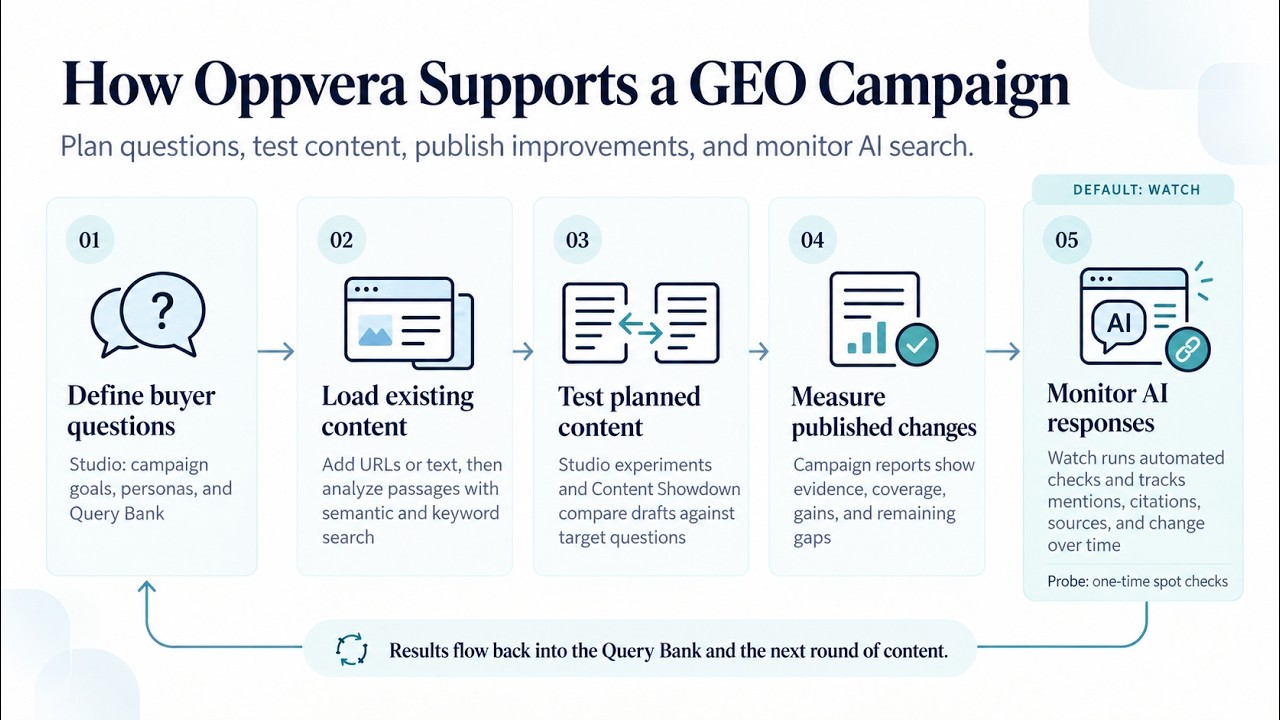
The basic workflow is:
Buyer questions → existing content → proposed content → testing → publication → AI search measurement
This turns GEO into a measurable content and information-retrieval problem.
Start With a Query Bank
Suppose a company has 100 pages on its website.
Those 100 pages are not necessarily the best way to define a GEO campaign.
Instead, imagine starting with 20 questions that customers might ask:
- What does this product do?
- How does it compare with an alternative?
- Does it support a particular use case?
- What are its limitations?
- Does it integrate with a particular technology?
- What type of organization normally uses it?
These questions form a query bank.
Some questions may already be answered extremely well. Others may expose gaps that are difficult to see by simply reviewing the website.
This distinction matters because modern AI search systems are fundamentally responding to queries and attempting to retrieve information relevant to those queries.
Google describes its generative search systems as using techniques including retrieval-augmented generation, where relevant web content is retrieved from Google’s search index to ground generated responses.[1]
Microsoft is exposing a similar concept directly through Bing Webmaster Tools. Its AI Performance reporting includes grounding queries — phrases associated with retrieval of content that was subsequently cited in AI-generated answers.[2]
The query is therefore a useful unit around which to design and measure a GEO campaign.
Ask Whether the Existing Content Answers the Question
Once the questions are defined, the next step is not necessarily to create content.
First, test what already exists.
A company’s useful information may be spread across:
- product pages
- documentation
- technical articles
- blog posts
- GitHub repositories
- support material
- PDFs
- other public documents
For each buyer question, the practical question becomes:
Which parts of our existing content are most relevant to this question?
This gets closer to how information retrieval systems work.
The page is important because it is what gets crawled and indexed, but the information needed to answer a particular question may be contained within only a small portion of that page.
That is why a useful GEO experiment can compare individual passages of existing content against a query rather than simply declaring an entire page “optimized” or “not optimized.”
Relevance Appears to Matter
Recent research provides some support for this approach.
A 2026 study examining 21,143 search-layer citations across ChatGPT, Google and Perplexity found that pages with greater influence on generated answers tended to be semantically aligned with the query, more structured, and richer in extractable evidence such as definitions, numerical facts, comparisons and procedural information.[3]
Another large controlled study conducted 252,000 trials across six language models to examine what caused one retrieved source to be cited ahead of another.
The strongest content-related factor the researchers identified was topical relevance.[4]
A 2026 survey reviewing 45 GEO studies reached a similar conclusion. Although it cautioned that GEO research is still young and that many proposed optimization techniques do not generalize reliably across systems, it identified topical relevance as one of the more reproducible factors observed in the research.[5]
This suggests a fairly durable principle:
Before worrying about GEO tactics, make sure you have good information that is relevant to the questions people are asking.
Find the Gaps Before Publishing More Content
This also changes how content planning works.
Instead of saying:
We need ten new articles this quarter.
A GEO campaign can ask:
Which important buyer questions are poorly answered by our existing information?
That creates a much more specific content-development problem.
Imagine that you test 20 questions.
Your existing content handles 13 very well.
Four are partially answered.
Three expose substantial information gaps.
Those three questions become reasonable candidates for new content.
This is consistent with Google’s current guidance for generative search. Google recommends creating useful, original content that fulfills people’s needs and explicitly cautions against producing large quantities of pages merely to cover variations of possible AI queries.[1]
The objective is therefore not to manufacture a page for every query.
It is to understand the information need behind the questions and determine whether the organization has useful, authoritative information that addresses it.
Test Proposed Content Before You Publish It
This is where GEO can start to resemble an engineering process.
If you identify an information gap, you can create a draft that attempts to address it.
You now have two versions:
Existing content
and
Proposed content
Run the same question against both.
- Did the proposed explanation become more relevant?
- Did another passage still rank ahead of it?
- Did changing the heading make the information easier to retrieve?
- Did adding a concrete example help?
- Did a clearer definition improve the result?
You can iterate on the draft before publishing it.
This does not reproduce the complete behavior of ChatGPT, Gemini, Copilot or any other production AI system. Those systems have their own crawling, indexing, retrieval, ranking, model and citation pipelines.
It does give you a controlled experiment for testing one important part of the problem:
Does this content appear to answer this question better than what we had before?
That is much more useful than simply guessing whether a draft “looks optimized for AI.”
Publication Is Not the End of the Experiment
After publication, a different type of measurement becomes possible.
Now you can ask external AI systems the same questions and observe what happens.
For example:
- Is the organization mentioned?
- Which sources are cited?
- Where does the organization appear in a list?
- What competing sources appear?
- Does the generated answer accurately represent the organization’s content?
- Does performance change over time?
Microsoft’s new AI Performance tools illustrate where this type of measurement is heading. Bing now reports which pages are cited in AI-generated answers, the grounding queries associated with those citations, and changes in citation activity over time.[2]
That closes an important loop.
You begin with questions.
You examine the content.
You improve gaps.
You publish.
Then you return to the same questions and measure what happened.
GEO Becomes a Continuous Experiment
This leads to a more useful way of thinking about GEO.
It is not simply:
Optimize the website for AI.
It is closer to:
Define an information need → measure how well your information satisfies it → improve the information → observe how real AI systems use it.
The questions provide continuity throughout the entire campaign.
They tell you what content to evaluate.
They reveal gaps.
They give you something against which to test proposed content.
And eventually they become the questions you run against production AI systems to measure visibility.
That is the workflow I demonstrate in the video using Oppvera.
Watch: Building a First GEO Campaign
In the tutorial, I build a small GEO campaign from beginning to end:
- creating a buyer-question query bank
- collecting existing website and document content
- identifying content gaps
- testing unpublished content in a retrieval simulation
- comparing existing and proposed passages
- running questions against a production LLM
- reviewing mention rate, rankings, GEO scores and actual AI responses
Watch: How to Build Your First GEO Campaign with Oppvera
Oppvera is a free environment for experimenting with these ideas and learning how AI search retrieval, selection and measurement work.
The important concept does not depend on any particular tool:
Start with the questions. Then determine whether your information deserves to be retrieved for those questions.
That provides a much stronger foundation for a GEO campaign than starting with a list of pages to optimize.
References
[1] Google Search Central. Optimizing your website for generative AI features on Google Search. Google, 2026.
[2] Microsoft Bing Webmaster Tools. AI Performance. Microsoft, 2026.
[3] Zhang, Kai; He, Xinyue; Yao, Jingang. From Citation Selection to Citation Absorption: A Measurement Framework for Generative Engine Optimization Across AI Search Platforms. arXiv:2604.25707, 2026.
[4] Vishwakarma, Rahul; Kumar, Shushant; Jamidar, Ratnesh. What Gets Cited: Competitive GEO in AI Answer Engines. arXiv:2605.25517, 2026.
[5] Martinez, Olivier. Optimizing Visibility in Generative Engines: A Critical Survey of Generative Engine Optimization (2023–2026). arXiv:2607.14035, 2026.