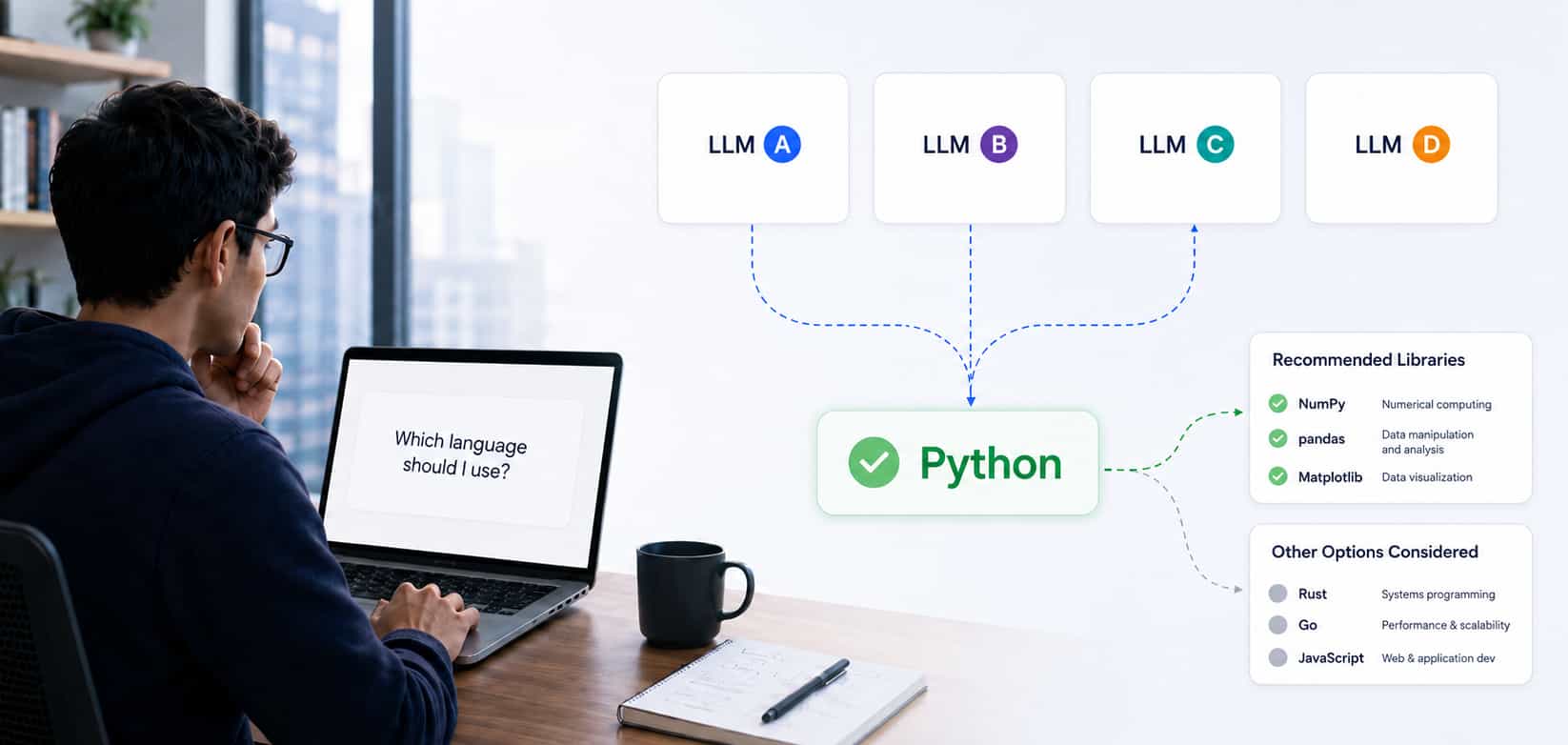
Large language models are increasingly part of the software development process. Developers use AI assistants to generate code, troubleshoot errors, select libraries, initialize projects, and make technical decisions.
As AI becomes more involved in these decisions, an important question emerges: When developers let an AI choose a programming language or library, how different are the choices made by different LLMs?
A recent research paper suggests that, in many cases, the choices are surprisingly similar.
In A Study of LLMs’ Preferences for Libraries and Programming Languages, researchers from King’s College London, University College London, GitHub Next, and BT Group examined technology choices made by eight large language models, including models from OpenAI, Anthropic, Meta, Alibaba/Qwen, DeepSeek, and Mistral.
The researchers found substantial similarities in the technologies these models selected, particularly when solving benchmark programming tasks.
Eight LLMs, similar technology preferences
The study, dated June 4, 2026, evaluated GPT-4o-mini, GPT-3.5-turbo, Claude 3.5 Sonnet, Claude 3.5 Haiku, Llama 3.2 3B, Qwen 2.5 Coder, DeepSeek LLM, and Mistral 7B.
Despite differences in model providers, architectures, and sizes, the LLMs frequently converged on the same technologies.
For Python library selection, all eight models produced similar distributions. The same three libraries consistently appeared at the top: NumPy, pandas, and Matplotlib.
The models also drew from a relatively narrow portion of the Python ecosystem. Each LLM used only 32 to 39 distinct libraries across hundreds of varied programming tasks, despite the thousands of Python packages available to developers.
Statistical comparisons also showed meaningful similarity. The researchers found a median rank correlation of 0.53 for library preferences across model pairs. For programming languages, the median correlation was 0.54.
So the models were not making identical decisions, but their choices were far from independent.
Python is an especially strong default
The similarity was particularly noticeable with programming languages.
Across the programming benchmarks, every model demonstrated a strong preference for Python. Overall, Python accounted for approximately 90 to 97 percent of generated solutions.
That preference continued even when researchers created scenarios where other languages might have clear technical advantages.
These included a low-latency trading platform, a high-performance parallel processing library, a system-level application, a concurrent web server, and a cross-platform graphical application.
Languages such as C, C++, Rust, or Go could reasonably be preferred for some of these applications because of performance, memory management, or concurrency requirements.
Yet Python was still the most frequently selected language in 23 of 40 model-and-task combinations, or 58 percent of cases.
The researchers concluded that LLMs can favor familiar and established technologies rather than always choosing the technology best suited to a particular task.
Popular libraries may receive an AI advantage
The same pattern appeared with libraries.
LLMs consistently favored established technologies, even when newer alternatives had gained significant developer adoption.
The researchers found pandas favored over Polars, Matplotlib and seaborn favored over Plotly, and Flask heavily favored over FastAPI.
In the web-server experiment, Flask appeared in 88 percent of responses, compared with only 9 percent for FastAPI.
The models sometimes selected familiar libraries even when they were unnecessary. NumPy was frequently imported for problems whose reference solutions did not use it.
These results suggest that LLMs may have strong defaults toward popular technologies.
Why might different LLMs make similar choices?
One explanation is the data on which coding models are trained.
Many LLMs learn from large collections of publicly available software, including GitHub repositories. Models are also frequently evaluated against similar coding benchmarks, many of which contain substantial amounts of Python.
Different models can therefore learn similar assumptions about what a typical software stack looks like.
The researchers warn that this could have a homogenizing effect on software development.
Popular technologies are heavily represented in existing code. LLMs learn those technologies and recommend or use them. Developers then generate more software using those technologies with AI assistance.
Over time, this could reinforce the position of technologies already favored by LLMs.
What LLMs recommend is not always what they use
One of the study’s most interesting findings is that asking an LLM which technology it recommends does not necessarily tell you what it will actually use.
Researchers compared explicit technology recommendations with the technologies models selected when generating projects.
For programming-language tasks, the top recommended language matched the language actually used in only 7 of 40 cases. Across these tasks, the models contradicted their own language recommendations 83 percent of the time.
An LLM might explain that Rust or C++ is appropriate for a performance-sensitive application, then generate the application in Python.
Tracking whether an AI mentions or recommends a product is not necessarily enough. It may also be necessary to test what the AI actually selects when asked to build something.
A new factor in developer technology adoption
The study does not show that every LLM always chooses the same technologies. The researchers found more variation in open-ended project initialization tasks than in standardized programming benchmarks.
But the overall pattern is significant.
Across eight different LLMs, researchers found common preferences for established libraries, an especially strong preference for Python, and measurable similarities in technology selection.
As AI assistants become more involved in building software, these preferences could increasingly influence technology adoption.
For developer-focused companies, the question may no longer be simply, “Can developers find our technology?”
A second question is becoming important:
“When an AI helps a developer solve this problem, is our technology among the options it considers and actually uses?”
Source: Lukas Twist et al., A Study of LLMs’ Preferences for Libraries and Programming Languages, arXiv:2503.17181v4, June 4, 2026. https://arxiv.org/html/2503.17181v4